



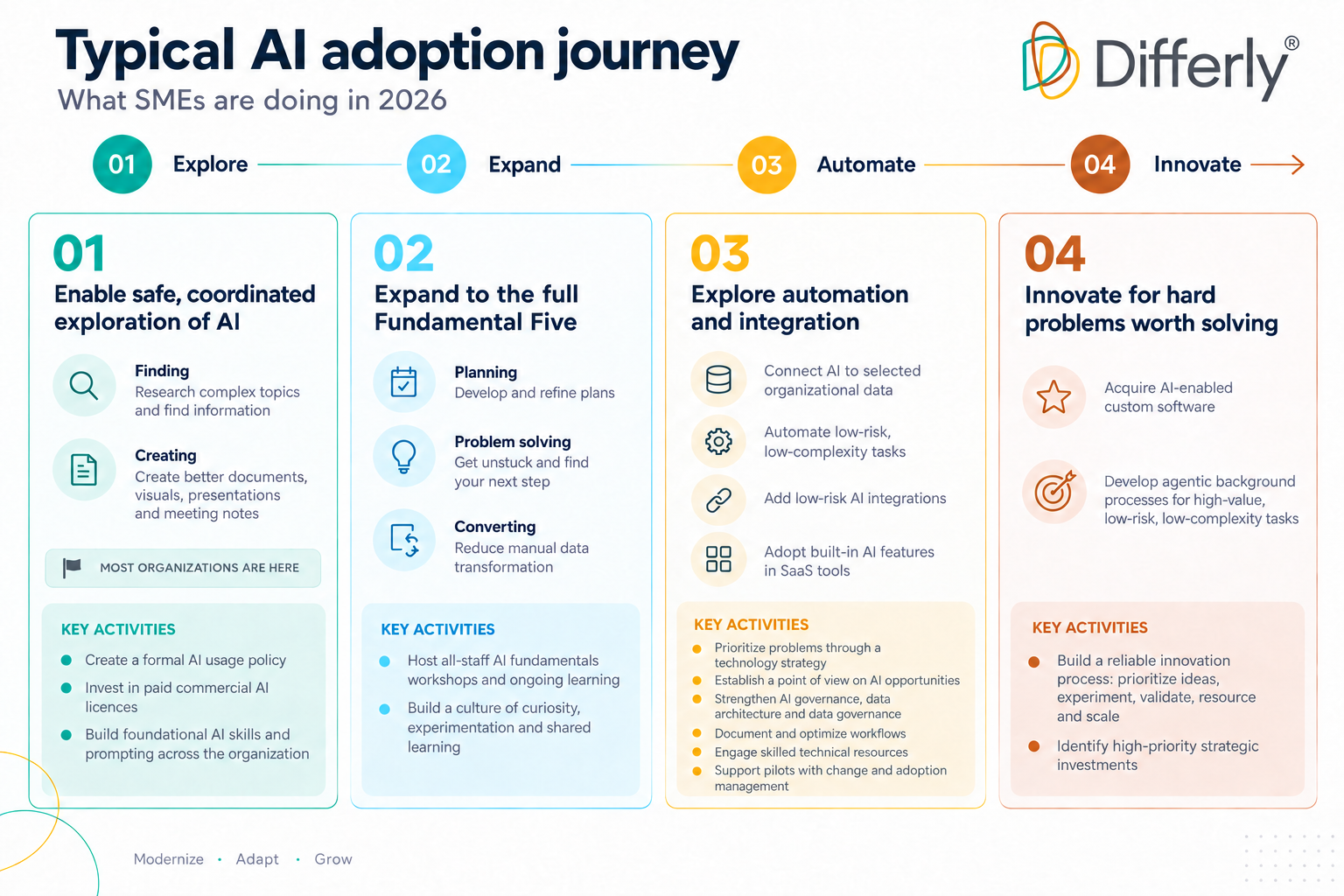
At one of our recent all-staff introductory AI workshops, our slide on the Four Stages of Adoption was the one that got the most phone cameras in the air. It’s a one-page synthesis of our first-hand experience with the practical realities of AI adoption.
Does your leadership team have a clear view of the capabilities you are trying to introduce with AI. Do you know exactly what it’s going to take to introduce them successfully? At Differly we have a useful vantage point when it comes to this question. We work with a broad range of organizations making steady progress in safely introducing AI tools and supporting teams in using them. We know that the hard part of technology adoption is the people and process bit. Success on these projects depends on a shared understanding of where we are today, where we want to go, and the steps that we need to take to get there.
Being a small and agile organization, we’re also lucky to be able to move quickly with AI for our own internal operations. AI supports both efficiency and effectiveness in many aspects of our business: reporting and analytics, operational and administrative coordination, research, document management and search, enhanced SharePoint functionality, and of course content production (aside: believe it or not, I drafted 100% of this article the old-fashioned way. As an enthusiast with quite a few maxed out AI subscriptions, I still often say that writing to communicate ideas is one of the least productive AI use-cases and is often counter-productive).
The combination of these two perspectives is what positions us at this useful vantage point: we’re very comfortable with what the latest tools can (and can’t) do when deployed to real business use cases, and we know what it takes to scale the impact and to accelerate time-to-value of technology investments in large organizations.
That’s why we created the AI Adoption Roadmap tool. It’s an interactive tool based on four stages we commonly observe in organizations. It helps leaders identify where they are today and consider what to do next. The tool allows you to save and print your results to discuss with others on your team. Down the road, you can sign back in to refresh the ‘current state’. And of course, we’re always available to discuss the recommended next steps in greater detail.
The genesis of this tool was a slide deck we made for one of our clients who needed to understand in simple terms where are we now and what’s next.
To understand where you are now, you need to have a well-grounded sense of the landscape around you. Leaders are constantly bombarded on YouTube and social media with content promoting extraordinary ways that AI can transform business. These are almost always over-hyped examples meant to attract views or sell products. The noise is distracting and creates an unhelpful sense of urgency. Our Typical AI Adoption Journey simplifies the landscape. It is a realistic and practical progression that leaders can guide their organizations through.
We recommend that most organizations start out with a focus on what we call the Fundamental Five: using commonly available AI tools to help with everyday tasks that involve Finding, Creating, Planning, Problem Solving, and Converting.
If you sit at a desk, much of the work you do everyday can fit into these five buckets and can benefit greatly from the latest AI tools sitting on your second monitor. From surveys we conduct with client organizations, typically only about 30% of staff are using AI on a regular basis. Of those, almost all of them are only using AI for one or two of these types of tasks.
Once the Fundamental Five are being used broadly, automations and direct connections to organizational data can be very impactful. They can also cause chaos and distraction while not working very reliably and costing a lot of money. This is why we recommend a structured approach to innovation in our suggested activities for the third stage of AI adoption.
Certainly, some companies may have an administrative pain point that is so laborious that diving right into automate it is an attractive solution. The risk of doing this in the absence of a more fulsome approach to innovation is that unreliable solutions result in wasted resources and – more importantly - will leave a trail of change resistant and pessimistic teams in their wake, making future AI solutions harder to adopt.
Success requires prioritization, broad alignment, focus, strong planning foundations, a culture of innovation-supporting behaviors, a well-considered approach to managing pilots, a plan to scale ideas that work, and access to people with the right technical skills.
The opportunity is real, and leaders who envision substantial AI-enabled modernizations of their businesses can start planning for these more advanced stages while their organizations move through Stages 1 and 2 at a pace of change that their people can handle.
You can find out where your organization sits today with our free, interactive AI Adoption Roadmap!

Ian loves helping organizations to solve challenging business problems and drive bottom-line impact by leveraging the latest in data and technology. He has over 20 years of experience guiding retail, B2C, and B2B environments in dramatically improving their operational efficiency and data-driven capabilities.
Ian is on Differly's AI workshop team, contributing to the development of AI use-case studies and building interactive tools that teach participants to use AI produtively.
Sign-up here and we'll send you our latest news, insights and blogs as they are published.